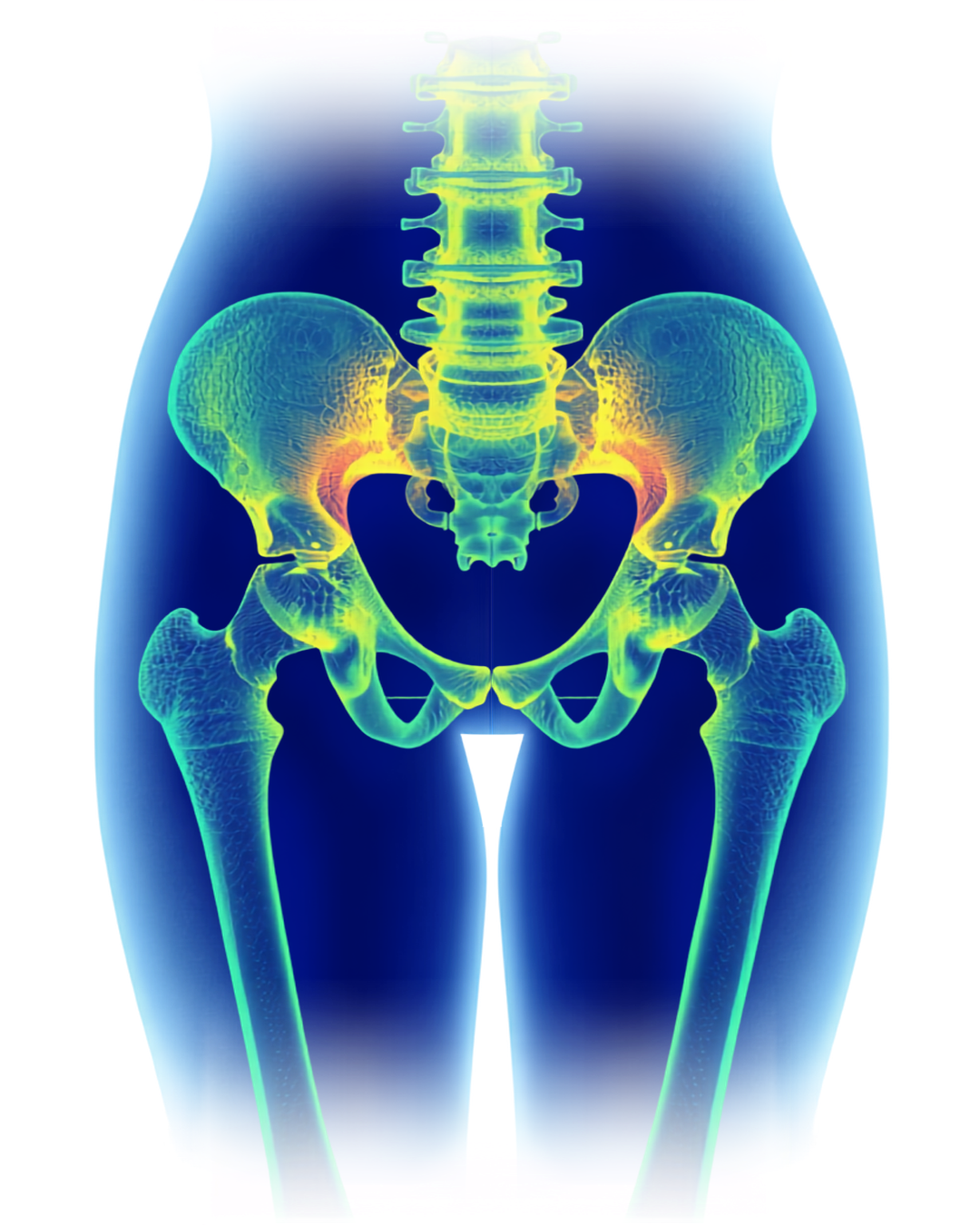
Conventional guidelines say to screen bone density at 65. But bone loss starts decades earlier — especially for women who had children later in life or breastfed. By the time you're screened, the window to act early is gone.
Conventional medicine has a clear rule for bone density screening: wait until 65. For a woman who becomes osteopenic in her 40s, that rule means the first look at her bones comes twenty years after the loss began.
We think that's twenty years too late. Here's why bone density deserves a place in your health picture long before 65 — and what a DEXA scan can tell you while there's still time to change the trajectory.
DEXA — dual-energy X-ray absorptiometry — is a painless, roughly 10-minute scan that uses a very low dose of radiation (less than a cross-country flight). It's the gold standard for measuring bone mineral density, and it also maps your body composition: lean muscle mass, body fat, and the visceral fat that surrounds your organs.
The body composition data matters — we use it to guide training, nutrition, and hormone protocols. But for women, the number we watch most closely is bone.
Your bone density result comes back as a T-score — a comparison of your bone density against that of a healthy young adult at peak bone mass. Here's how to read it:
Osteopenia rarely announces itself. There are no symptoms, no pain, nothing you can feel. The first sign is often a fracture — and by then, the years when prevention was easiest are behind you.
You reach peak bone mass around age 30. From there, bone is a use-it-or-lose-it tissue — and for women, several forces can pull density down years or decades before conventional screening would ever catch it:
Put those together and it's common for a woman in her 40s or early 50s to already be osteopenic — while feeling completely fine, and 15 to 20 years away from her first recommended screening.
Osteopenia caught early is one of the most actionable findings in preventive medicine. Bone responds to the right signals at any age — but it responds best when you start early:
Each of these works better with a baseline. A DEXA scan turns "I should probably think about bone health someday" into a number you can track, train against, and re-test.
The heart attack at 50 began at 30 — and the hip fracture at 70 began with quiet bone loss at 45. Waiting until 65 to look at your bones means giving up the two decades when you could have changed the outcome most easily.
If any of the risk factors above sound like you, it's worth a conversation. We'll help you understand your bone health in context — your labs, your history, your goals — and build a plan to protect it for the long haul.
Event invites, new articles, and the occasional note from Danielle. No spam — unsubscribe anytime.